KPIs: The Word “Key” Is Doing a Lot of Heavy Lifting
Most small businesses measure the wrong things. Here’s how to fix that.
There’s a word in the phrase “Key Performance Indicator” that most business owners skip right over.
Not performance. Not indicator.
Key.
Key means essential. Non-negotiable. The handful of metrics that, above everything else, tell you whether your business is healthy, growing, or quietly heading in the wrong direction.
It doesn’t mean every number you can pull from your POS system. It doesn’t mean the revenue figure you check every morning. And it certainly doesn’t mean a spreadsheet with 40 columns that nobody reads.
Key means ruthlessly selected. Deliberately tracked. Consistently acted on.
That distinction is everything.
Why Most Small Businesses Get This Wrong
Walk into most small businesses and ask the owner what their KPIs are. You’ll get one of two responses.
The first: a blank stare. KPIs are something they’ve heard about but never implemented, something for “bigger” companies with analytics teams and quarterly board meetings.
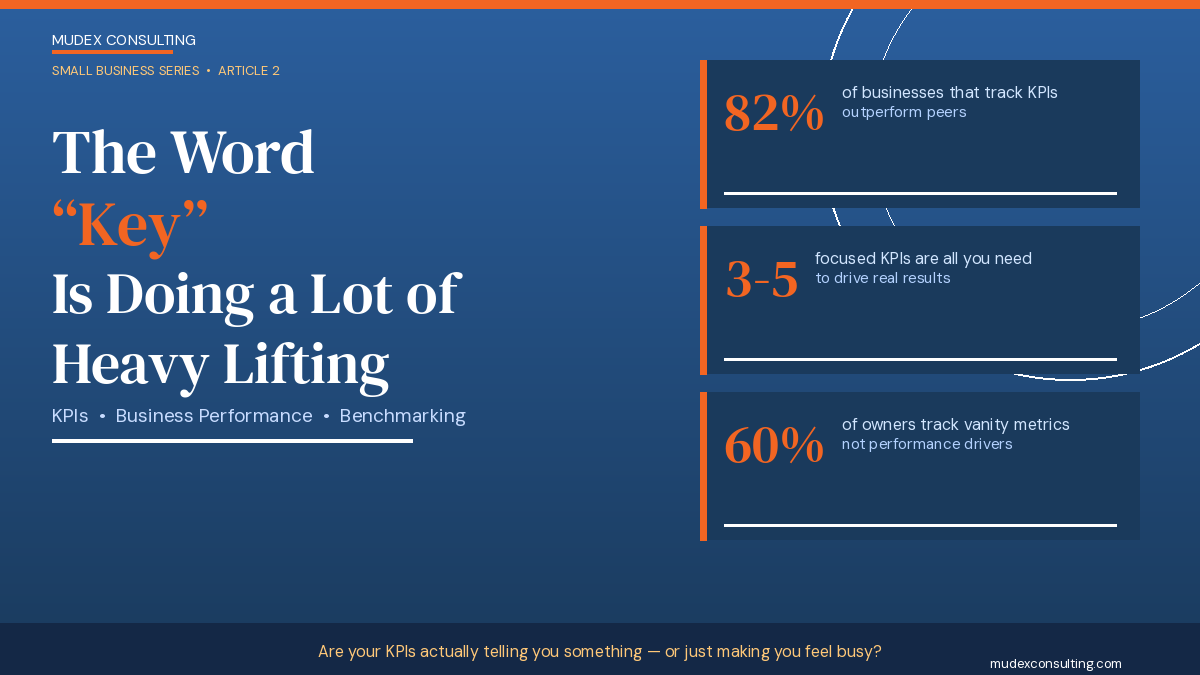
The second: a list of vanity metrics. Revenue. Social media followers. Number of transactions. Numbers that feel good to look at but don’t actually tell you whether the business is moving in the right direction.
Neither response comes from laziness or ignorance. It’s simply that nobody ever showed most small business owners which numbers actually matter, and more importantly, what those numbers should look like.
That last part is critical. A KPI without a benchmark is just a number. It only becomes useful when you know what it should be.
The Benchmark Problem: Why It Matters More Than You Think
Here’s a question most small business owners can’t answer: is your gross margin good?
You might know the number. Let’s say it’s 42%. But is 42% strong, average, or a warning sign?
The answer depends entirely on your industry. A restaurant running a 42% gross margin is doing well. A software company running 42% is leaving significant money on the table. A retail shop at 42% might be right on the industry average, or dangerously below it, depending on their category.
This is why benchmarking against industry standards isn’t optional. It’s the entire point of tracking KPIs in the first place.
Your numbers only tell a story when they’re measured against something. That something is your industry. What do the best operators in your space look like? What does average look like? Where does your business sit on that spectrum, and what does the gap tell you about where to focus?
Without that context, you’re not managing a business. You’re reading tea leaves.
The KPIs That Actually Matter for Small Businesses
With the principle of key firmly in mind, here are the metrics that most small businesses should be tracking, and the industry context that gives them meaning.
Gross Profit Margin What it is: Revenue minus the direct cost of delivering your product or service, expressed as a percentage. Why it matters: This is the foundation of your business model. If your margins are thin, every other problem gets amplified. If your margins are strong, you have room to invest, absorb setbacks, and grow. Industry benchmark context: Retail typically runs 20–50%. Restaurants 60–70% on food (before labor). Service businesses 50–70%. Professional services 70–80%+.
Customer Retention Rate What it is: The percentage of customers who return within a defined period. Why it matters: Acquiring a new customer costs five times more than retaining an existing one. Your retention rate tells you whether your product, service, and experience are strong enough to earn repeat business, the most profitable kind. Industry benchmark context: Varies widely, but any rate below 60% warrants serious attention. Strong service businesses typically retain 75–85%+ of customers annually.
Revenue Per Employee What it is: Total revenue divided by number of employees (including owners). Why it matters: This metric cuts through the noise of revenue growth and tells you how efficiently your team generates output. Growing revenue while revenue per employee declines means you’re scaling costs faster than output, which is a profitability warning sign. Industry benchmark context: Retail averages $100K–$200K per employee. Professional services $150K–$300K+. Restaurants typically $50K–$80K.
Average Transaction Value What it is: Total revenue divided by number of transactions. Why it matters: A flat transaction count with rising average value means your customers are buying more, a sign of strong upsell strategy and customer trust. Declining average value with flat revenue means you need more customers just to stay even, which is an unsustainable treadmill. Industry benchmark context: Compare month-over-month and year-over-year. Industry comparisons are less meaningful here than your own trend line.
Customer Acquisition Cost (CAC) What it is: Total sales and marketing spend divided by number of new customers acquired. Why it matters: If it costs you $200 to acquire a customer who spends $150 with you once and never returns, you’re losing money on every new customer. CAC only makes sense when measured against lifetime customer value. Industry benchmark context: Should always be less than 30% of customer lifetime value. Service businesses often target CAC below $50–$150 depending on contract size.
Net Promoter Score (NPS) What it is: A single-question survey (“How likely are you to recommend us?”) scored on a 0–10 scale. Why it matters: Word of mouth is the most powerful marketing channel available to a small business. NPS gives you a consistent, comparable measure of how likely your customers are to send you referrals. Industry benchmark context: Scores above 50 are considered excellent. Above 70 is world-class. Below 0 means more detractors than promoters, which is a serious signal.
Trending in the Right Direction Is Everything
Here’s the thing about KPIs that most business guides miss: a single data point is almost meaningless.
What matters is the trend.
A gross margin of 45% is great, unless it was 52% six months ago. A customer retention rate of 70% is decent, unless it was 58% last year, in which case it’s a significant improvement worth doubling down on.
KPIs are not a report card. They’re a compass. They tell you which direction you’re moving, and whether that direction is intentional or accidental.
The businesses that use KPIs most effectively review them on a consistent schedule, monthly at minimum, weekly for fast-moving metrics like revenue and transaction volume. They ask two questions every single time: is this moving in the right direction? And if not, what specifically is causing the movement?
That second question is where the real management happens.
Building Your KPI Practice Without Overcomplicating It
You don’t need a business intelligence platform or a dedicated analyst to run a strong KPI practice. You need three things:
A small, carefully chosen set of metrics, no more than five to seven to start. Remember: key.
A consistent way to track them. Even a simple spreadsheet, updated monthly, is enough to spot trends.
An honest benchmark to measure against, your industry average, your own historical performance, or ideally both.
Start there. Pick your five. Find your benchmarks. Track them every month without fail. Review the trends. Ask what’s driving them.
Do that consistently for six months and you will understand your business in a way that most small business owners never achieve, not because they’re not smart enough, but because nobody ever gave them the framework to do it.
The Bottom Line
The word “Key” in KPI is not a suggestion. It’s a filter.
Out of everything you could measure, what are the five to seven numbers that would tell a smart observer exactly how healthy your business is, where it’s heading, and what needs attention?
Find those numbers. Benchmark them against your industry. Track them consistently. Act on the trends.
That’s not corporate management theory. That’s just running a business well, at any size.
At Mudex Consulting, we help small and medium-sized businesses identify the right KPIs, benchmark them against industry standards, and build the tracking systems that turn data into decisions.
Ready to get clarity on your numbers? Visit us at mudexconsulting.com or send us a message. We’d love to talk.
#SmallBusiness #KPI #BusinessStrategy #ProcessImprovement #SMB #OperationalExcellence #BusinessGrowth #Entrepreneurship