Why Every Small Business Needs Fortune 500-Level Thinking
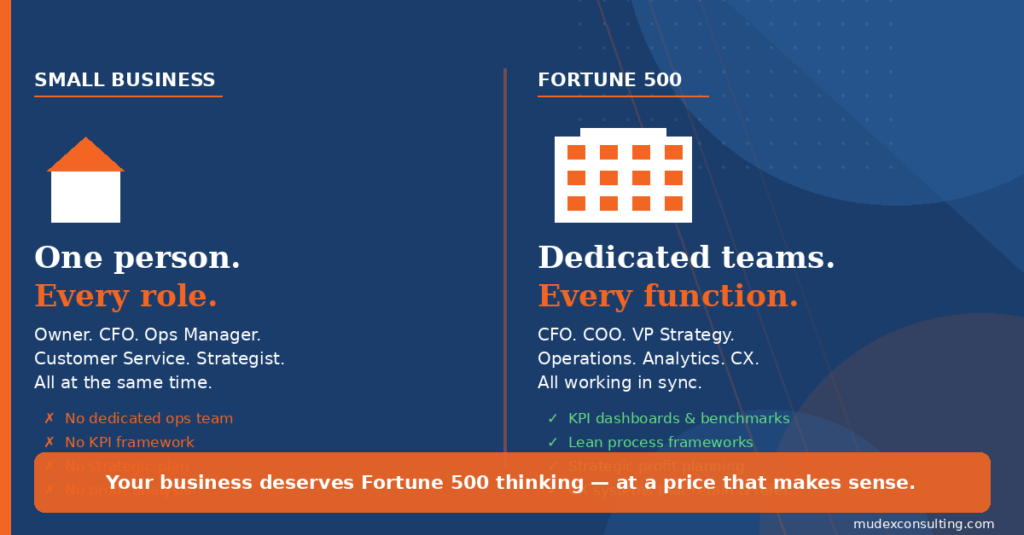
The playing field is uneven. But it doesn’t have to be.
Walk into any Fortune 500 company and you’ll find a Chief Financial Officer watching the numbers, a Chief Operations Officer streamlining processes, a VP of Customer Experience making sure every touchpoint is deliberate, and a strategy team benchmarking performance against the competition.
Now walk into most small businesses.
The owner is doing all of those jobs. Usually at the same time. Usually between answering the phone, managing staff, and trying to figure out why last month’s numbers looked the way they did.
This isn’t a criticism. It’s simply the reality of running a small business. And it’s also one of the biggest reasons small businesses struggle to grow — not because of a bad product or poor service, but because the business itself isn’t being run like a business.
A Business Is a Business — Regardless of Size
Here’s a truth that often gets overlooked: the fundamental principles that make a Fortune 500 company successful are the same principles that make any business successful. Size changes the scale. It doesn’t change the rules.
Every business — whether it has 5 employees or 50,000 — needs to know its numbers. Every business needs efficient processes. Every business needs a customer experience strategy. Every business needs to understand where its profit is coming from and where it’s leaking out.
The difference isn’t that large companies need these things and small businesses don’t. The difference is that large companies have entire departments dedicated to them.
A retailer with two locations and eight employees needs to understand their gross margin just as much as Walmart does. A plumbing company with a crew of four needs efficient scheduling and job costing just as much as a construction conglomerate. A restaurant owner needs to understand their customer retention rate just as much as any hospitality chain.
The principles don’t change. The tools and scale do.
The Gap Nobody Talks About
When we talk about why small businesses fail, we tend to focus on the obvious — cash flow problems, slow sales, tough competition. And those things are real.
But underneath most of those symptoms is a structural problem: small business owners rarely have access to the kind of operational expertise that could prevent those issues in the first place.
Large companies invest heavily in process improvement, performance measurement, strategic planning, and leadership development. They have people whose entire job is to make the business run better. They use frameworks, data, and systems to make decisions — not gut feel alone.
Most small business owners don’t have that. Not because they don’t want it. Because it hasn’t been accessible or affordable.
That’s the gap.
The C-Suite Problem — and the Smarter Solution
The obvious answer seems simple: hire the expertise. Bring in a CFO, an operations manager, a strategy consultant. Get the brains in the room.
The problem is the price tag.
A full-time Chief Operations Officer costs anywhere from $150,000 to $300,000 a year in salary alone. A seasoned CFO runs similar numbers. A VP of Customer Experience adds another six figures on top. For a small business generating $500,000 to $2 million in annual revenue, that math simply doesn’t work.
So most small business owners go without. They make do. They figure it out as they go. And the business suffers — not dramatically, not all at once, but slowly. In the form of inefficiencies that never get fixed. Profit that never gets captured. Customers who quietly stop coming back.
But here’s what the most successful small business owners have figured out: you don’t have to hire full-time executives to get executive-level thinking.
The smarter, more affordable approach is to bring in specialized consulting expertise on a fractional or project basis. Pay for the expertise when you need it, applied directly to your specific challenges, without the overhead of a full-time salary, benefits, and office space.
This model gives a small business owner access to the same quality of strategic thinking, operational discipline, and performance measurement that Fortune 500 companies rely on — at a fraction of the cost.
What This Looks Like in Practice
It means having someone look at your operation through a process improvement lens and identify where you’re losing time and money to unnecessary steps, rework, and friction.
It means tracking the right KPIs — not just revenue, but the leading indicators that tell you where your business is heading before problems become crises.
It means having a profit strategy that goes beyond “sell more” — one that looks at pricing, margin, cost structure, and untapped revenue sitting inside your existing customer base.
It means designing a customer experience that doesn’t happen by accident, one that retains more customers, generates more referrals, and builds a reputation that does your marketing for you.
None of this requires a Fortune 500 budget. It requires the right expertise, applied at the right time, in the right way for a business of your size.
The Mindset Shift That Changes Everything
The most important thing a small business owner can do isn’t work harder. It’s start thinking about their business the way a CEO thinks about theirs.
That means stepping out of the day-to-day long enough to ask strategic questions. Where is the waste? Where is the untapped profit? Where are customers falling through the cracks? What would this business look like if it ran with the discipline of a well-managed company — not just the hustle of a hardworking owner?
Small businesses are the backbone of the economy. They deserve access to the same quality of thinking that powers the largest companies in the world.
The good news is — that access exists. And it’s more affordable than most business owners realize.
If you’re a small business owner thinking about what it would mean to run your business with more operational clarity and strategic discipline, I’d love to connect. Drop a comment below or send me a message.
#SmallBusiness #BusinessStrategy #ProcessImprovement #Entrepreneurship #OperationalExcellence #SMB #BusinessGrowth #Leadership